
Read Walthall County Property Tax Records
The Walthall vendor tax portal opens the door to the roll, map, and valuation links. Treat value, class, exemption, district, and payment fields as one calculation rather than scattered numbers. The appraisal record sets the base. The collector record shows what was billed. It also shows what was actually paid.
| Field | What It Shows | Where |
|---|---|---|
| True value | Mass-appraisal estimate of full value | Appraisal record |
| Assessed value | Ratio-based amount used for tax | Land roll |
| Exemption | Approved relief shown on the assessment | Assessor |
| Bill and status | Charge, payment, installment, or delinquency | Collector |
| Tax district | County, school, and municipal rate combination | Portal and parcel record |
Mississippi applies a 10 percent assessment ratio to owner-occupied residential property and 15 percent to general real property. Millage is charged on assessed value. It never applies straight to a deed price. Exemptions and district rates can push the final bill well away from any market estimate, so read each piece before comparing totals.
Check the Walthall District Before the Rate
The millage table breaks rates into county, school, municipal, and total columns. Outside town, the municipal rate is zero. Inside Tylertown it runs 59. A 39667 mailing address alone does not settle the question. Compare the city-limit and tax-district fields before trusting any row. Getting the district right keeps a parcel near the town edge from being billed under the wrong rate. Save the millage year beside the rate. Both the values and the district tables can shift over time. Note: A tax district is a billing geography, not proof of a parcel's legal boundary or ownership.
Walthall's Four-Year Appraisal Rotation
According to the Appraisal Office, staff thoroughly ride 25 percent of Walthall County each year and spot-check the rest, covering the whole county on a four-year cycle.
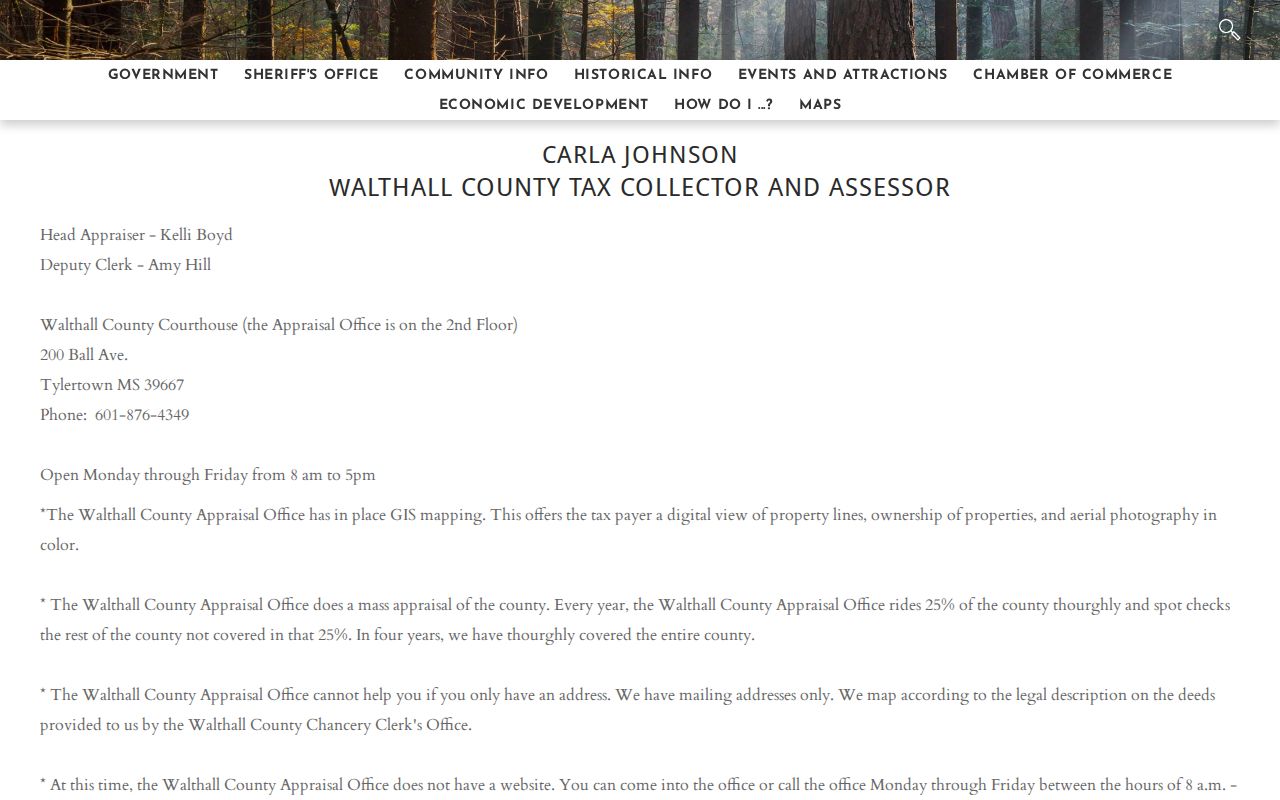
The county's page explains its GIS and the appraisal cycle. A new value can follow a field review, a changed improvement, a land characteristic, or a reclassification, even without a sale. Ask which effective date and parcel characteristics control the figure you see.
File Walthall Homestead in the County Window
The county's homestead instructions set the filing window from January through April and identify January 7 as the deed-filing point.
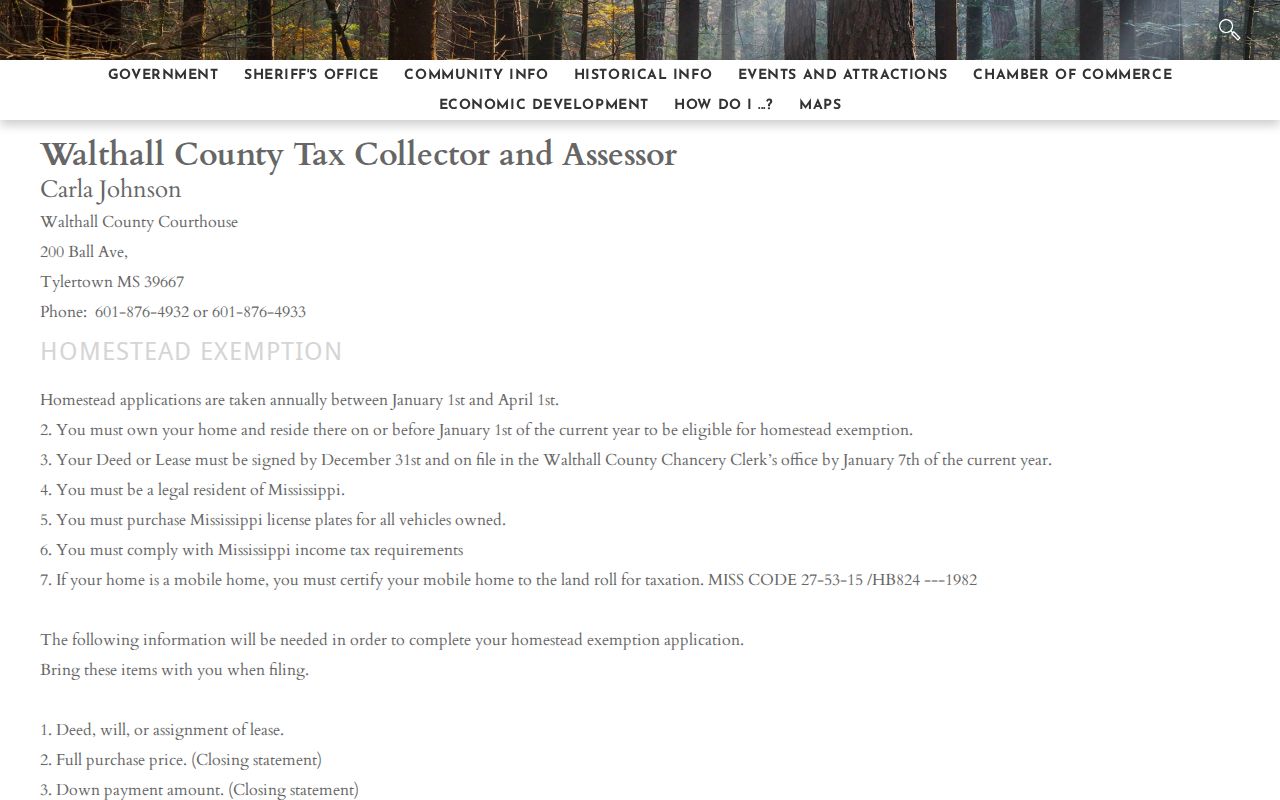
The office's checklist tells applicants which documents to bring. A change in ownership, marital status, or occupancy can require re-signing. Keep your filing record, and later confirm the exemption lands on the correct tax year.
Look Up a Walthall County Tax Bill
The portal displays an effective year of 2026. Confirm that year before reading any balance. Rural street addressing can fail, so fall back on PPIN, parcel ID, owner name, legal description, or map selection when the address search stalls.
- Identify the parcel in the tax portal or Walthall Parcel Viewer.
- Record the effective year, assessed value, district, charge, and displayed payment status.
- Compare the land roll for class, exemption, and January 1 owner context.
- Call 601-876-4932 or 601-876-4933 about an unclear payoff, delinquency, or sale status.
- Assessed value
- The ratio-based tax base derived from true value.
- Mill rate or levy
- The combined rate imposed by the applicable taxing authorities.
- Homestead exemption
- Approved relief tied to a qualifying principal home.
- Tax lien
- A legal claim for unpaid tax, distinct from a mere old portal balance.
Walthall Due Dates, Sale, and Redemption
Per the county tax page, land taxes are due February 1. Installments are allowed. Paying in November can earn an early-payment discount. Delinquent land goes to sale on the last Monday in August under the county process. A stated two-year redemption period applies. These stages shift over time, so get a current status straight from the collector. A third party may pay a bill. Payment alone transfers no title. An old delinquency display does not prove a sale happened or that redemption has expired.
Verify tax demands. Mississippi warns about fake distraint-warrant letters threatening seizure. Use official county or state contacts, never the phone or link in a suspicious notice.
Search State Liens Separately
The Mississippi DOR tax-lien registry notice covers liens filed from January 1, 2015 onward. It supplements rather than replaces Walthall County property tax records. Match the taxpayer and filing carefully. Request any recorded local instrument from the Chancery Clerk. Keeping the sources apart stops a statewide mix-up. A name match can then be pinned to the wrong local parcel.
January 1 Controls the Walthall Land Roll
Mississippi property-tax guidance and the county's own instructions both treat the land roll as a dated record. Ownership is keyed to January 1. Taxes are paid a year in arrears. Walthall County warns that a buyer generally shows up on the following year's land roll. Those rules apply to the current roll. They can make a correct tax page look out of step with a deed recorded after the roll date. For a recent sale, track three dates separately: the deed's execution and recording date, the land-roll year, and the bill year. Confirm the transfer through the Chancery Clerk. Do not force a new meaning onto the tax record. The seller's name on a bill can reflect the statutory roll date, not a title conclusion. Date discipline matters for exemptions too. A new owner may have recorded a deed. But the parcel may not yet have reached the roll or that year's filing point. Ask the Assessor which year's application controls. Ask which ownership facts control too. Do not assume the online name settles eligibility.
Calculate Walthall Tax in the Right Order
The vendor's taxation guide lays out the roles of county, city, and school taxing authorities. Mississippi DOR guidance supplies the basic relationship among true value and assessment ratio. It also covers assessed value and millage. Order matters. Applying a mill rate to true value produces the wrong result.
- Start with the appraisal office's true or market-value estimate for the effective year.
- Confirm the property classification and apply the state assessment ratio to obtain assessed value.
- Check whether an approved homestead exemption changes the taxable result.
- Match the parcel's tax district to the current county, school, and municipal millage row.
- Compare the calculation with the actual collector bill, which remains the source for the amount due.
A mill is one dollar of tax per thousand dollars of assessed base. The formula explains the structure only. It cannot replace the bill, because exemptions, district coding, rounding, and other record details can all move the posted amount.
Public Access Beyond the Walthall Portal
The portal is not the only door. The Walthall County Tax Assessor/Collector sits at 200 Ball Avenue in Tylertown. The staff answers two lines, 601-876-4932 and 601-876-4933. Call or visit when the portal cannot match a rural address. Call when the effective year is confusing. Call when an exemption seems absent, or when payment and sale status must be confirmed right now. Property records questions like these usually end at a counter rather than a screen.
Make the request precise. Give the PPIN or parcel number. Give the owner name exactly as the land roll spells it, plus a legal-description hint, the tax year, and the specific item you need. One clean request for a land-roll entry, a bill, payment status, an exemption record, or sale information beats a vague plea for everything held on a parcel. If the office does not routinely hand out an existing public record, route the request to the true custodian. Cite the Mississippi Public Records Act.
That statute expects prompt production of records. It permits a written explanation when gathering them takes longer. It also allows lawful fees and redactions. It does not force an office to build a custom analysis that never existed. Ask for the existing electronic or paper record first. When copies or research might carry a charge, request a cost estimate up front.
Tax-Sale Status Requires More Than One Screen
A delinquent tax bill starts a process. It rarely ends one. The collector's property records cover the balance and the sale itself, while Chancery deed records may hold confirmations, title matters, redemption papers, or disputes. The parcel card adds identity and legal clues. When a purchase, an estate, or a claimed ownership interest hangs on the answer, check all three before drawing any conclusion.
Write down the details while you work. Record the year of delinquency, the sale date, the purchaser's name exactly as listed, the redemption deadline the office states, and any Chancery book, page, instrument, or case number. Then ask whether later payment, redemption, cancellation, or court action changed things. An undated screenshot or copied list goes stale fast.
Mississippi's state DOR lien registry is a separate system. A state lien and a county land-tax delinquency can both touch the same property, yet they come from different records. Never merge them on a matching name alone.
Note: Confirm any Walthall County tax sale and redemption with the collector and the controlling recorded files before relying on an ownership claim.
Contest a Walthall County Assessment
Start with the appraisal office. Ask for the property characteristics and the math behind the value, then compare acreage, classification, improvements, legal description, and exemption against what you know. Mississippi's appeal guidance lays out the Review Board and Board of Tax Appeals routes. Form 50-001-10 captures the notice, the issue, your contact details, and the deadline.
Protect the deadline. Use the date on the current notice and appeal form. Paying under protest can preserve a refund claim, but does not replace a timely appeal.
Back each claimed error with the record that speaks to it. A deed or survey settles acreage; photographs and measurements support improvement disputes; current evidence supports classification. Keep proof of filing. Ask which review level comes next.