
Walthall County Deed Types
The Chancery Clerk keeps Walthall County deed records at the courthouse. The land indexes reach beyond deeds. They also cover deeds of trust, mortgages, releases, plats, lis pendens, construction liens, federal tax liens, judgments, wills, and chancery matters. A deed records a claimed transfer. Related entries add debts, releases, court disputes, or mapped divisions touching the same land.
| Deed Type | What It Does | Common Use |
|---|---|---|
| Warranty deed | Conveys land with stated title promises | Ordinary sale |
| Quitclaim deed | Conveys only the interest the signer may hold | Family transfer or title cleanup |
| Trustee's deed | Conveys under authority stated in the instrument | Trust or foreclosure-related transfer |
| Executor's deed | Conveys property through estate authority | Probate administration |
| Tax deed | Documents a transfer tied to a tax sale | Tax-delinquent land |
A deed is not the same as a deed of trust or a lien. One transfers title. The other records a claim or security interest against the land. A release can later show that a recorded claim was satisfied. Search all of these under every name variant. Then compare legal descriptions, dates, and book/page references before treating two entries as part of one property history.
Walthall Deeds Stay Offline
The county's Chancery Clerk page states plainly that deeds are not online. The public may inspect land records at 200 Ball Avenue in Tylertown. Hours are Monday through Friday, 8:00 a.m. to 5:00 p.m. The clerk maintains general grantor and grantee indexes plus sectional indexes. A call to 601-876-3553 before a visit can confirm hours and the right index.
Walthall County publishes no public grantor-grantee portal. The courthouse index is the working route. A precise phone inquiry can also serve, or a written request with names, approximate dates, the legal description, and any known book/page. A focused Mississippi Public Records Act request may also help. Actual search and production costs can apply.
Parcel Clues for Walthall Deeds
The public Walthall Parcel Viewer can supply a PPIN, parcel ID, owner name, deed date, deed book and page, acreage, subdivision, and section-township-range details. Its configuration lacks a normal text search. That means land may need to be found on the map. It can also be found through an owner, road, or nearby parcel.
One sample parcel points to deed book 2025, page 158. Its deed is dated December 10, 2024. Its legal fragment reads "NW/4 SW/4 LESS RD ROW." Yet the same result lists a Seattle mailing address. It also shows a zero-like situs field. That split shows why a mailing place, a physical site, and a legal land description are not interchangeable.
The official Chancery Clerk source records the county's deed access and office details. It confirms that courthouse indexes, not a public online deed database, are the current route. Those indexes lead to Walthall County property records.
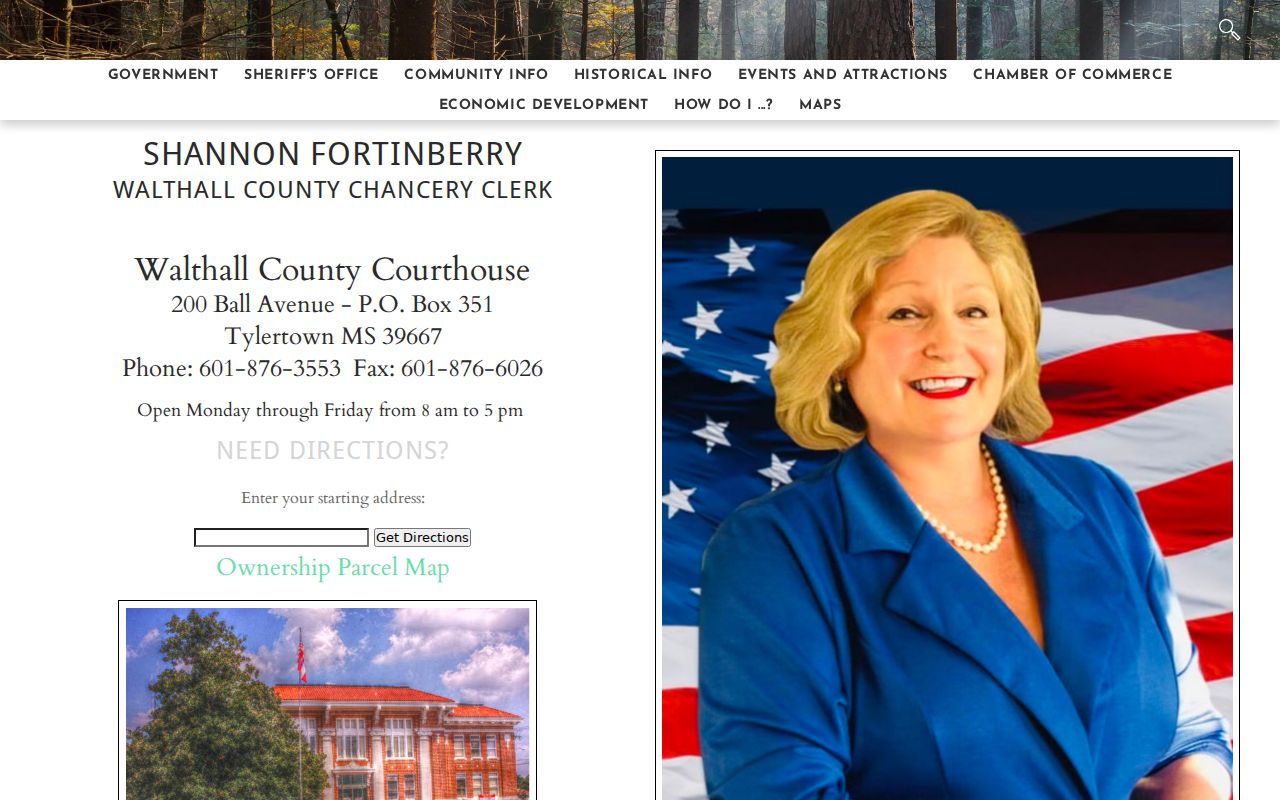
Walthall County deed research still runs through the courthouse indexes.
Walthall's Grantor-Grantee Index
Names organize the general index. A grantor gives an interest. A grantee receives it. The sectional index offers a land-based route when names change or an old deed uses a rural legal description. Together these tools link Walthall County deed records into a chain of title, the ordered sequence of recorded transfers tied to the tract.
- Take the current owner and deed book/page from the parcel layer as leads.
- Find that acquisition under the owner's name as grantee.
- Read the grantor, legal description, date, and prior references.
- Search the grantor's acquisition when tracing farther back.
- Cross-check the sectional index, plats, releases, and chancery entries.
- Grantor
- The party shown as conveying an interest.
- Grantee
- The party shown as receiving that interest.
- Chain of title
- The linked sequence of recorded transfers for one tract.
- Book and page
- The volume and page locator used to retrieve a Walthall instrument.
Walthall Deed Filing Rules
Walthall County's filing instructions call for an original or authorized copy. Signatures are required. Acknowledgments or notary treatment must appear as well. The document also needs the preparer's name, address, and phone number. The same instructions list the grantor, grantee, property address, legal description, and return address as needed details.
The posted fee is $26 for the first five pages. Each added page costs $1. A document that breaks the formatting rules may draw an extra $10 fee. These figures can change, so confirm the charge and submission rules before recording Walthall County deeds.
Pre-1910 Walthall Deed Trails
Walthall County was carved out in 1910. Its land came from Marion and Pike counties. Land from before that year may sit outside the Walthall deed index. Its paper trail can continue under a former county instead. The Mississippi Department of Archives and History catalogs Walthall government records covering 1913 through 1955. A broader county-record series runs from 1799 to 1980.
The Walthall County Library offers another route. Its holdings include a Marion County land-deed index for 1812 through 1846. Wills, marriage books, newspapers, and WPA material sit there too. Staff can help with a precise book/page or newspaper question. Broad deed research is beyond what they take on. When the Walthall chain stops at county formation, search Marion and Pike next. Their deed, tax, probate, and tract sources pick up the trail.
Walthall Plat Names Unlock Deeds
Old subdivision names outlast street addresses in Walthall County deeds. The courthouse nomination cites Conerly and Ball Addition. It covers Lot 1 and the south half of Lot 2 in Square C, under Book 18, page 131. The depot nomination points to Lot 9, Square H, Section 25, Township 2 North, Range 11 East. That lot sits in the NOGN Addition, tied to Plat of Survey 1624.
Treat these as leads, not as proof of a modern parcel match. Request the cited plat first. Then trace later splits and deeds through the deed records. Historic Tylertown maps dated 1962, 1972, 1978, 1985, 2002, 2004, and 2010 can explain road and town changes. The recorded instruments supply the legal link between past and present ownership.
Legacy Walthall Deed Links
A legacy Delta Computer Systems page still surfaces in search results. It shows subscription language with a July 2016 cutoff notice. It is not a working Walthall County deed search. Read it as a historical artifact. Do not read it as evidence that newer deeds are missing or that an online search is complete.
That distinction matters. Current county instructions direct the public straight to the courthouse. They state plainly that deeds are not online. Rely on the county office page as the access authority. Date any screen capture from an outside vendor. When an old page conflicts with the clerk's current guidance, ask the clerk which system controls before trusting either result.
Log Each Walthall Deed Result
A solid deed file records far more than the owner of record. Write down the exact index title, volume, page, instrument date, recording date, grantor, grantee, deed type, preparer, notary, consideration if shown, and every prior-book reference. Copy the full legal description, exceptions and all. A phrase such as “LESS RD ROW” can matter even when the parcel looks simple on a plat or GIS map.
Track the source too. Note whether each item came from an original book, a clerk copy, a certified copy, a parcel-layer lead, an archive catalog, or a historic nomination. Date each portal capture, since current county pages, vendor screens, and legacy links can disagree about access or office details. A short status tag keeps things straight. Verified means the custodian supplied it; lead means another record points toward it; unavailable means the relevant source did not expose it.
The log pays off later. It also keeps a deed date from being confused with the day it was recorded or placed on the land roll.
Once you find a deed, request it at the clerk's counter or through a focused phone or written inquiry. The county says a newly recorded document should be open for public viewing by the next day. Self-service copies run 25 cents per page, staff-made copies 50 cents per page, and certification adds $1. Give the clerk the deed book/page, party names, date, and a short land clue from the parcel number or legal description.
The county access instructions recommend an attorney, title company, or abstractor for a full title search. That task differs from asking for one deed copy. A certified copy authenticates the custodian's copy; it does not state that the seller held clear title.
Copies of Walthall County Deeds
Once you find a deed, request it at the clerk's counter. A focused phone or written inquiry works too. The county says a newly recorded document should be open for public viewing by the next day. Self-service copies run 25 cents per page, and staff-made copies 50 cents per page. Certification adds $1. Give the clerk the deed book/page, party names, and date. Add a short land clue from the parcel number or legal description.
The county access instructions recommend an attorney, title company, or abstractor for a full title search. That task differs from asking for one deed copy. A certified copy authenticates the custodian's copy. It does not state that the seller held clear title.
Recorded, not guaranteed. Walthall County deed records show what reached the clerk. They do not rule out an unrecorded interest or replace a professional title search.